




On a chilly September afternoon on Nova Scotia’s Bay of Fundy coast, a sea turtle lay motionless on the beach. At first, people passing by thought the animal had died. Then its eyes moved. Michelle Pope, who discovered the turtle, was surprised to see a sea turtle in such cold northern waters. The turtle was later named Lucky. Lucky was identified as a Kemp’s ridley sea turtle, considered the world’s most endangered sea turtle species. Researchers believe she was a female between three and five years old. She was among nine sea turtles recorded suffering from extreme cold in Atlantic Canada during the 2025–2026 season. Remarkably, Lucky was the only one that survived.
Sudden cold weather – A rapid drop in water temperature can cause cold stunning, leaving turtles too weak to swim.
Kemp’s ridley turtles normally live in the Gulf of Mexico and warmer tropical waters, making Lucky’s appearance so far north unusual. However, scientists are increasingly reporting cold-stunned sea turtles across the North Atlantic. They suggest that changing ocean temperatures and shifting currents may be altering the traditional movements and feeding ranges of these animals.
Changing ocean currents – Shifts in currents can carry turtles long distances away from their normal range.
During autumn, young sea turtles can travel northward with warmer ocean currents and spend time feeding along the northeastern Atlantic coast. Because turtles are ectothermic, their body temperature depends largely on their surroundings. When seawater falls to around 10°C (50°F) or lower, their bodies can become dangerously cold.
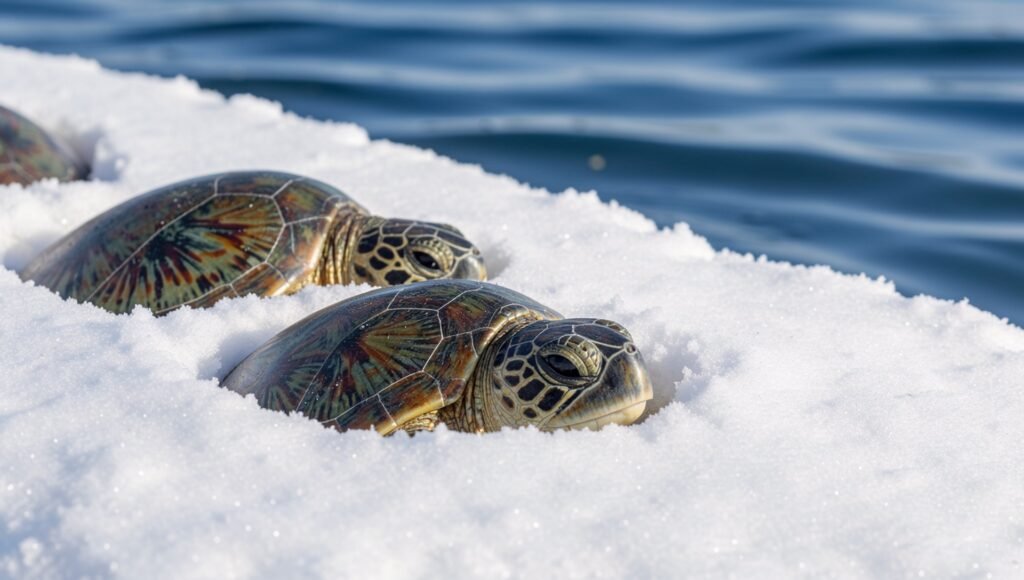
This condition, known as cold stunning, causes their body temperature to fall, weakens their muscles and slows their heartbeat. Unable to swim or dive normally, affected turtles may drown or become helplessly adrift. Eventually, strong winds, waves and tidal currents can push them onto beaches—sometimes hundreds or thousands of kilometres away from the waters where they normally live.
How Stranding Can Affect the Birth Rate of Endangered Sea Turtles
Understanding the connection between juvenile survival, reproduction, and changing ocean conditions
Can Stranding Reduce the Birth Rate?
Stranding far from their normal habitat can indirectly reduce the birth rate of endangered sea turtles. The main reason is that many turtles must survive for several years before they become mature enough to reproduce. When juvenile turtles become cold-stunned, exhausted, trapped, or exposed to unsuitable environmental conditions, some may die before reaching adulthood.
When fewer young turtles survive to breeding age, the future population contains fewer reproductive adults. This does not necessarily mean that a turtle’s ability to lay eggs immediately changes. Instead, increased mortality among juveniles can reduce the number of turtles available to reproduce in later years.
Why Juvenile Survival Matters
Sea turtles have complex life cycles and can spend many years growing before reaching sexual maturity. During this period, young turtles face threats from unsuitable temperatures, limited food, predators, fishing activity, pollution, and other environmental pressures.
A turtle that dies before reaching reproductive age cannot contribute offspring to the next generation. Therefore, repeated strandings or difficult environmental conditions that increase juvenile deaths can have consequences that appear years later in the population.
The Population Connection
- Juvenile turtles must survive long enough to reach maturity.
- Only mature turtles can contribute directly to reproduction.
- Higher juvenile mortality can reduce the future number of breeding adults.
- Fewer breeding adults can result in slower population recovery.
Changing Ocean Temperatures and Currents
Ocean temperatures and currents influence where sea turtles can travel, feed, and find suitable habitat. Changes in these conditions may alter traditional feeding grounds and migration routes. Turtles that are carried into colder or otherwise unsuitable waters can become stressed or vulnerable to cold-stunning.
Temperature changes can also affect the distribution of marine organisms that turtles depend on for food. If feeding areas become less productive or move away from established migration routes, turtles may have to travel farther to obtain enough energy.
Food Availability and Reproductive Health
Adequate nutrition is important for growth, body condition, and reproduction. When turtles cannot obtain enough food, they may have less energy available for growth and other biological functions. Poor body condition can make it more difficult for young turtles to survive until maturity.
Changes in marine food webs can therefore have indirect consequences for sea turtle populations. Small schooling fish such as sardines are an important part of many marine food webs, transferring energy from plankton to larger predators. Changes in marine ecosystems can affect the availability and distribution of food resources used by different species.
How Higher Mortality Can Slow Population Growth
Population growth depends on the balance between births, deaths, immigration, and emigration. For endangered sea turtles, losing juveniles before they become adults can be particularly important because those turtles represent potential future breeders.
If mortality remains high for many years, fewer turtles may reach reproductive age. This can create a delayed effect: a population may experience high juvenile losses today, while the reduction in breeding adults becomes more noticeable years later.
Why Protecting Stranded Turtles Matters
Rescue and rehabilitation efforts can help some stranded turtles survive and return to suitable habitat. Preventing unnecessary deaths is particularly valuable for endangered populations because every surviving juvenile represents a potential future breeding adult.
Protecting important feeding areas, migration routes, nesting beaches, and other habitats can also support long-term population recovery. Understanding why turtles strand and how ocean conditions influence their movements can help conservation programs identify areas where intervention may be most useful.
Conclusion
Stranding does not automatically reduce the birth rate of sea turtles. However, repeated strandings and environmental stress can increase mortality, especially among juveniles that have not yet reached breeding age. If fewer young turtles survive to adulthood, the population may eventually have fewer reproductive individuals.
Changing ocean temperatures, currents, migration routes, and food availability can add to these pressures. Over time, a combination of increased mortality and reduced reproductive potential may contribute to slower population growth, making conservation and habitat protection especially important for endangered sea turtles.


