


Chapter 3: Finnish Space Organizations and Research Institutes
Modern space exploration depends not only on rockets and satellites but also on a strong network of research institutions, universities, government agencies, and innovative private companies. Finland has developed exactly such an ecosystem. Although the country does not operate its own large launch facilities or human spaceflight program, it has created internationally respected organizations that contribute scientific knowledge, advanced engineering, and cutting-edge technologies to numerous global space missions. These organizations work together to study Earth, the Sun, planets, and the wider universe while developing technologies that benefit both space exploration and life on Earth.
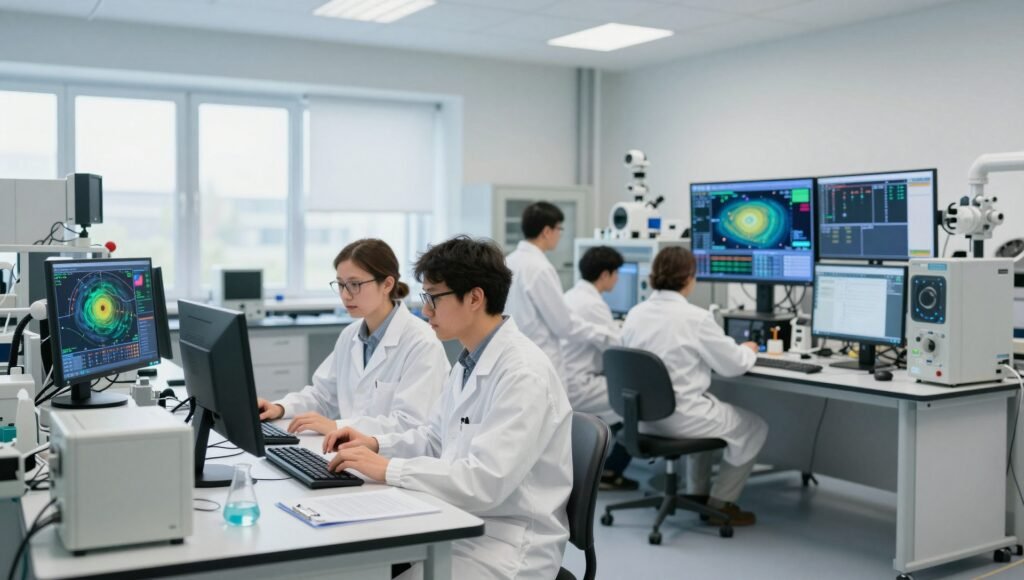
One of the most influential institutions in Finnish space research is the Finnish Meteorological Institute (FMI). Although many people associate the institute primarily with weather forecasting, its role extends far beyond predicting daily weather conditions. The institute has become a global leader in atmospheric science, climate research, satellite observations, and space weather monitoring.
Scientists at the Finnish Meteorological Institute investigate how Earth’s atmosphere interacts with the Sun and space environment. They develop sophisticated instruments capable of measuring atmospheric particles, plasma, radiation, magnetic fields, and environmental conditions both on Earth and aboard spacecraft. Many of these instruments have been included in international space missions, allowing Finnish researchers to collect valuable scientific data from distant regions of the Solar System.
The institute also plays a crucial role in studying climate change. Satellites equipped with advanced sensors continuously observe Earth’s atmosphere, oceans, forests, snow cover, and sea ice. Finnish researchers analyze this information to improve weather forecasts, monitor environmental changes, and understand long-term climate trends. These observations help governments prepare for natural disasters, improve agricultural planning, protect ecosystems, and reduce the impacts of climate change.
Another pillar of Finnish space research is Aalto University. Established through the merger of several leading institutions specializing in technology, economics, and design, Aalto University has become one of Europe’s most innovative centers for satellite engineering and aerospace education.
Aalto University gained international recognition through its pioneering work in CubeSat technology. CubeSats are miniature satellites built using standardized modular designs that dramatically reduce development costs while providing valuable scientific capabilities. Students and researchers at Aalto University designed, constructed, tested, and operated Finland’s first student-built satellites, demonstrating that high-quality space missions could be accomplished with relatively modest resources.
Building a satellite provides students with practical experience in nearly every field of engineering. They learn spacecraft design, mechanical engineering, electronics, software development, telecommunications, power systems, thermal control, mission planning, and systems integration. This hands-on education prepares graduates for careers in both the space industry and many other high-technology sectors.
Research at Aalto University extends beyond satellite construction. Scientists investigate remote sensing, Earth observation, artificial intelligence, autonomous systems, communication technologies, advanced materials, and sustainable spacecraft design. These research activities help Finland remain competitive in the rapidly expanding global space economy.
The University of Helsinki also plays a central role in advancing Finnish space science. As one of the country’s oldest and most respected universities, it has built internationally recognized research programs in astronomy, astrophysics, planetary science, atmospheric physics, and computational modeling.
Astronomers at the University of Helsinki study stars, galaxies, black holes, exoplanets, and the large-scale structure of the universe. Using both ground-based observatories and space telescope data, researchers investigate how stars are born, evolve, and eventually die. They also examine the formation of galaxies and search for planets that may support conditions suitable for life.
Planetary scientists at the university collaborate with international space agencies to study Mars, asteroids, comets, and the Moon. Finnish researchers help develop scientific instruments capable of analyzing planetary surfaces, atmospheres, dust particles, and magnetic environments. These studies improve our understanding of how planets formed billions of years ago and how they continue to evolve today.
The university is also highly respected for its work in computational astrophysics. Modern astronomy generates enormous volumes of observational data that require advanced computer modeling and artificial intelligence techniques. Finnish scientists develop algorithms capable of processing satellite observations, simulating cosmic events, and identifying previously unknown astronomical phenomena.
Beyond universities, Finland’s research ecosystem includes several specialized laboratories focusing on plasma physics, atmospheric chemistry, radio science, materials engineering, and space instrumentation. These laboratories often work together on interdisciplinary projects that combine expertise from multiple scientific fields. Engineers, physicists, computer scientists, chemists, and environmental researchers collaborate to solve complex problems that no single discipline could address alone.
One area where Finnish institutions excel is instrument development. Scientific instruments carried aboard spacecraft must withstand extreme temperatures, intense radiation, powerful vibrations during launch, and years of operation in the vacuum of space without maintenance. Designing such equipment requires extraordinary precision and reliability.
Finnish engineers have developed compact sensors capable of measuring magnetic fields, charged particles, atmospheric gases, radiation levels, dust particles, and plasma conditions. These instruments have flown on satellites orbiting Earth as well as on missions exploring other parts of the Solar System. Their compact size, low power consumption, and high reliability make them especially valuable for modern space missions where every gram of payload matters.
Government support has played an essential role in building Finland’s space research capabilities. National funding programs encourage universities, research institutes, and private companies to work together on ambitious scientific projects. Rather than separating academic research from industrial innovation, Finland promotes close cooperation between scientists and businesses.
This collaborative approach has produced numerous successful technology companies specializing in satellite systems, remote sensing, navigation, Earth observation, telecommunications, software engineering, and artificial intelligence. Many startups began as university research projects before expanding into commercial enterprises serving customers around the world.
The growth of Finland’s commercial space sector has been particularly impressive. Companies now design satellite components, imaging systems, onboard computers, communication equipment, propulsion technologies, and software for processing satellite data. Some specialize in environmental monitoring, using satellite imagery to help governments manage forests, agriculture, fisheries, infrastructure, and disaster response.
Artificial intelligence has become an increasingly important area of research within Finnish space organizations. Machine learning algorithms can automatically analyze satellite images, detect environmental changes, identify natural disasters, classify land cover, and predict weather patterns. AI also assists spacecraft operations by improving navigation, optimizing communication, and detecting equipment anomalies before they become critical failures.
International collaboration remains at the heart of every major Finnish space organization. Finnish researchers work closely with scientists from Europe, North America, Asia, and other regions through joint missions, research partnerships, and technology development programs. These collaborations allow Finland to contribute specialized expertise while gaining access to world-class facilities, launch opportunities, and scientific data.
Participation in international missions has enabled Finnish organizations to contribute to studies of Earth’s climate, the Sun’s activity, Mars’ atmosphere, comet composition, asteroid properties, and many other scientific objectives. By focusing on specific areas of excellence, Finland has earned a reputation as a reliable and innovative partner in global space exploration.
Education remains one of the greatest strengths of Finland’s research institutions. Students are encouraged to participate directly in real scientific missions rather than simply studying theory in classrooms. Many undergraduate and graduate students contribute to satellite design, instrument development, software programming, data analysis, and mission operations. This practical experience produces highly skilled scientists and engineers who are well prepared for careers in both research and industry.
As the global space sector continues to expand, Finnish organizations are preparing for new challenges. Future research will include autonomous satellites, quantum communication, advanced robotics, sustainable spacecraft technologies, lunar exploration, and more sophisticated Earth observation systems. Finnish institutions are also investigating how artificial intelligence, cloud computing, and advanced sensor networks can transform the way space missions are conducted.
The success of Finland’s space organizations demonstrates that scientific leadership is built through collaboration, innovation, and continuous investment in education. Although Finland is a relatively small nation, its research institutes and universities have become essential contributors to international space science. Their work not only expands humanity’s understanding of the universe but also develops technologies that improve weather forecasting, environmental protection, communication, navigation, disaster management, and countless aspects of modern life. In the next chapter, we will explore how Finland entered the exciting world of satellites and became a pioneer in the development of small spacecraft.


