


Chapter 1: Finland’s Journey into Space Science
Finland may not be the first country that comes to mind when people think about space exploration, yet it has quietly become one of Europe’s most innovative contributors to modern space science. With a population of only around 5.6 million people, Finland has demonstrated that scientific excellence depends more on knowledge, creativity, and collaboration than on geographical size or economic power. Through decades of investment in education, engineering, environmental science, and advanced technology, Finland has built an impressive reputation in satellite development, space weather research, Arctic observation, and international scientific cooperation. Today, Finnish researchers and engineers contribute to some of the world’s most sophisticated space missions, working alongside scientists from Europe and many other parts of the world.
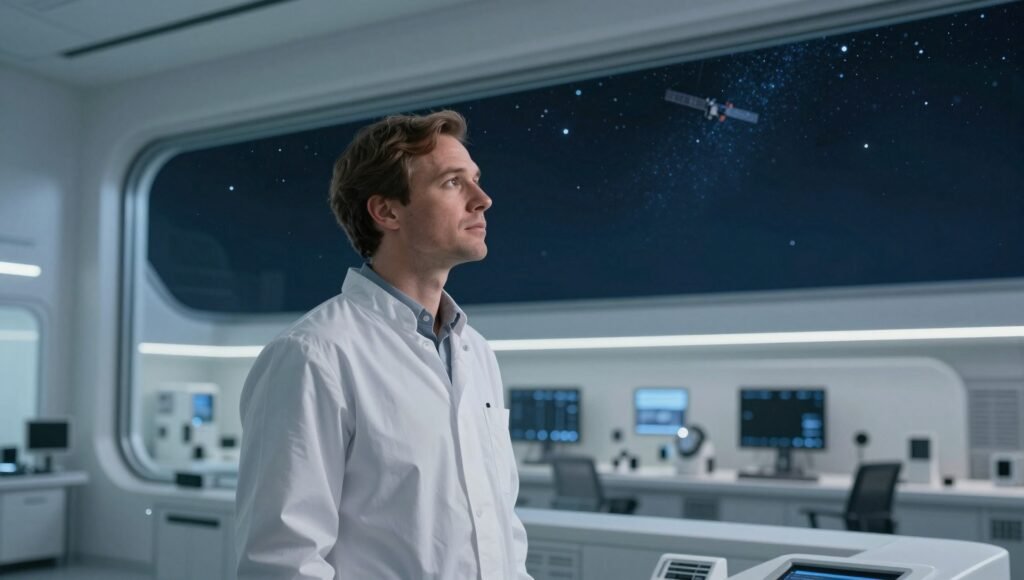
Space research is far more than launching rockets into orbit. It is the study of the universe, the development of technologies that benefit life on Earth, and the search for answers to some of humanity’s oldest questions. Finland has embraced this broader vision by focusing on areas where it can make unique contributions. Instead of competing directly with countries that have large launch facilities or human spaceflight programs, Finland specializes in advanced scientific instruments, Earth observation technologies, small satellites, atmospheric research, and Arctic science. These fields are increasingly important as the world faces climate change, environmental challenges, and the need for more accurate global monitoring systems.
The story of Finland’s space research begins long before the country built its own satellites. Finnish scientists have been studying the skies for centuries. Early astronomers carefully observed the movement of stars, planets, and the spectacular aurora borealis, also known as the Northern Lights. Located close to the Arctic Circle, Finland provides an excellent natural laboratory for observing space weather and the interaction between the Sun and Earth’s magnetic field. These unique geographical advantages inspired generations of scientists to investigate the mysteries of the upper atmosphere and near-Earth space.
During the twentieth century, Finland expanded its scientific capabilities by investing heavily in universities and research institutions. Engineers developed expertise in electronics, telecommunications, computing, and environmental sciences. These strengths later became valuable assets in the rapidly growing field of space technology. Finnish universities established research groups dedicated to astrophysics, satellite engineering, remote sensing, plasma physics, and atmospheric science. Young scientists gained international experience by participating in collaborative research projects across Europe and beyond.
A major turning point came with Finland’s increasing involvement in European space cooperation. Rather than developing an entirely independent national space program, Finland chose to work closely with international partners. This strategy allowed Finnish researchers to contribute specialized technologies to ambitious missions while sharing knowledge and resources with other countries. The country’s membership in European scientific organizations opened new opportunities for research funding, advanced engineering projects, and participation in planetary exploration missions.
One of Finland’s greatest strengths lies in its ability to design highly reliable scientific instruments. Space missions require equipment capable of surviving extreme temperatures, intense radiation, vacuum conditions, and years of operation without maintenance. Finnish engineers have become experts in developing compact sensors, imaging systems, plasma analyzers, and environmental monitoring devices that can operate under these demanding conditions. These instruments have flown aboard satellites, spacecraft, and scientific missions studying Earth, Mars, comets, asteroids, and the Sun.
Another remarkable area of Finnish achievement is small satellite technology. In recent decades, miniature satellites known as CubeSats have transformed access to space. These compact spacecraft are significantly less expensive than traditional satellites while still carrying sophisticated scientific instruments. Finnish universities and startups quickly recognized the potential of this technology. Students, researchers, and engineers collaborated to design satellites capable of monitoring Earth’s atmosphere, studying environmental conditions, testing new communication systems, and demonstrating innovative engineering solutions. These projects have not only advanced scientific knowledge but have also trained a new generation of aerospace professionals.
Finland’s location makes it particularly valuable for studying Earth’s changing climate. Arctic regions are warming faster than most other parts of the planet, making continuous observation essential for understanding global climate change. Satellites equipped with Finnish technologies help monitor sea ice, snow cover, forests, lakes, cloud formation, and atmospheric composition. These observations support weather forecasting, disaster management, environmental conservation, agriculture, and scientific research worldwide. Data collected from space allows scientists to detect subtle environmental changes that would be impossible to observe consistently from the ground alone.
Space weather research has become another internationally recognized Finnish specialty. The Sun constantly emits streams of charged particles and magnetic energy that interact with Earth’s magnetic field. During periods of intense solar activity, these interactions can produce beautiful auroras but may also disrupt satellite communications, navigation systems, aviation, and electrical power grids. Finnish researchers have spent decades studying these phenomena, developing mathematical models and monitoring systems that improve our understanding of solar storms and their effects on modern technological infrastructure.
Innovation has always been central to Finland’s scientific culture. The country encourages close collaboration between universities, government research organizations, and private companies. This partnership has created a thriving space technology ecosystem where scientific discoveries are rapidly transformed into practical applications. Finnish companies now develop advanced satellite components, imaging systems, software, sensors, communication technologies, and data analysis tools used by customers around the world. Many of these innovations have applications beyond space exploration, benefiting industries such as environmental monitoring, telecommunications, transportation, healthcare, and national security.
Education plays a vital role in sustaining Finland’s achievements in space research. Finnish schools emphasize critical thinking, scientific curiosity, and problem-solving from an early age. Universities provide world-class programs in physics, engineering, computer science, mathematics, environmental science, and astronomy. Students often participate directly in real satellite projects, giving them valuable hands-on experience before they begin professional careers. This educational approach ensures that Finland continues to produce highly skilled scientists and engineers capable of addressing future technological challenges.
International collaboration remains essential to Finnish space research. Modern space missions are often too complex and expensive for any single country to undertake alone. Finnish scientists work alongside researchers from numerous nations, contributing specialized expertise while benefiting from shared knowledge and resources. These collaborations strengthen scientific diplomacy, promote peaceful exploration, and accelerate discoveries that benefit humanity as a whole.
Looking toward the future, Finland is expected to play an even greater role in the rapidly evolving global space economy. Advances in artificial intelligence, satellite constellations, autonomous spacecraft, quantum technologies, and commercial spaceflight are creating exciting new opportunities. Finnish researchers are actively exploring these emerging fields while continuing to contribute to climate monitoring, planetary science, space weather forecasting, and advanced engineering. As humanity prepares for new missions to the Moon, Mars, and beyond, Finland’s scientific expertise will remain an important part of international exploration efforts.
Finland’s journey into space science demonstrates that determination, education, innovation, and collaboration can enable even a relatively small nation to make significant contributions to humanity’s understanding of the universe. Its achievements remind us that space exploration is not reserved for a few powerful countries but is a global endeavor built upon shared knowledge, scientific curiosity, and the collective pursuit of discovery. In the chapters that follow, we will explore the remarkable institutions, technologies, missions, and people that have made Finland one of Europe’s most respected contributors to modern space research.


