


Chapter 2: The History of Space Research in Finland
The history of Finland’s space research is a story of steady scientific progress, international cooperation, and technological innovation. Unlike countries that began their space programs with ambitious rocket launches or human spaceflight missions, Finland built its reputation by investing in education, scientific research, and engineering excellence. Over several decades, Finnish scientists transformed a nation known primarily for its forests, lakes, and Arctic landscapes into one of Europe’s respected contributors to space science. Today, Finland’s expertise in satellite technology, space weather, atmospheric physics, and remote sensing is recognized around the world.
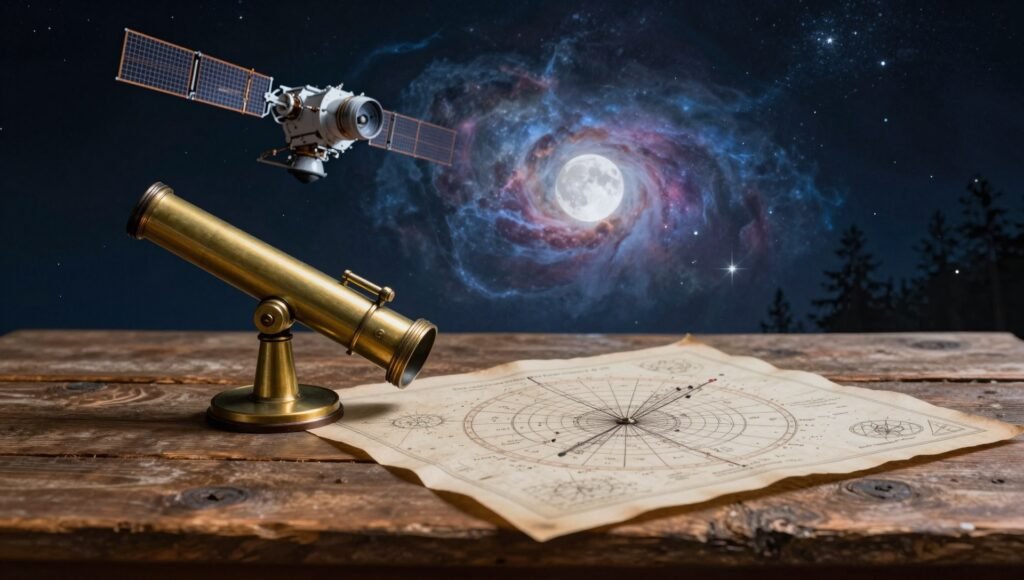
The roots of Finnish space science can be traced back to the country’s long tradition of astronomy. For centuries, Finnish scholars observed the movements of stars, planets, and the Moon using increasingly sophisticated instruments. Early astronomers sought to understand celestial mechanics, predict eclipses, and improve navigation. Living at high northern latitudes also gave Finnish observers a unique opportunity to study the spectacular aurora borealis, one of nature’s most fascinating phenomena. These colorful displays inspired scientific curiosity and encouraged researchers to investigate the interaction between the Sun and Earth’s magnetic field.
During the nineteenth century, Finland experienced significant advances in education and scientific research. Universities expanded their programs in mathematics, physics, and natural sciences, creating a foundation for future technological development. Astronomical observatories were established to conduct systematic observations of the night sky, while researchers improved their understanding of celestial objects and atmospheric processes. Although space exploration as we know it today had not yet begun, these scientific activities laid the groundwork for Finland’s future involvement in space research.
The twentieth century brought rapid technological progress across the world. Advances in electronics, radio communications, aviation, and computing transformed scientific research. After the launch of the first artificial satellite, Sputnik 1, in 1957, space science entered a completely new era. Satellites demonstrated their enormous potential for communication, navigation, weather forecasting, and scientific observation. Finnish scientists quickly recognized that space technology would become increasingly important, not only for astronomy but also for environmental monitoring, telecommunications, and national development.
Instead of attempting to build an independent launch capability, Finland adopted a strategic approach based on specialization. The country invested in scientific fields where it already possessed strong expertise, including atmospheric physics, plasma research, electronics, and environmental science. Finnish universities expanded research programs in space-related disciplines, attracting talented students and building laboratories capable of developing advanced scientific instruments. This emphasis on quality over quantity became one of Finland’s defining characteristics in international space research.
One of the country’s greatest advantages has always been its geographical location. Situated close to the Arctic Circle, Finland provides ideal conditions for studying Earth’s upper atmosphere and magnetic environment. Scientists established observation stations that continuously monitored auroras, geomagnetic activity, ionospheric conditions, and atmospheric changes. These observations became increasingly valuable as satellite communications and navigation systems expanded, because solar storms can interfere with electronic technologies around the world.
During the 1960s and 1970s, Finnish researchers became more involved in international scientific collaborations. Space research was becoming increasingly global, with countries sharing data, expertise, and technological resources. Finnish scientists participated in European research programs, exchanging knowledge with colleagues from neighboring countries and contributing to joint investigations of Earth’s atmosphere and near-space environment. These partnerships allowed Finland to gain experience without the enormous financial burden of operating an independent space agency comparable to those of larger nations.
The rapid growth of computer technology during the 1980s and 1990s further accelerated Finland’s progress. Advances in software engineering, digital electronics, and telecommunications strengthened the country’s technological capabilities. Finland became internationally recognized for innovation in mobile communications and information technology, creating expertise that proved highly valuable in satellite engineering and remote sensing applications. The same engineering principles used in telecommunications could often be adapted for spacecraft systems, allowing Finnish companies and research institutions to contribute advanced technologies to international missions.
An important milestone in Finland’s space history was its increasing participation in the activities of the European space community. By working closely with the European Space Agency and other international organizations, Finnish scientists gained access to large-scale scientific missions that would have been impossible to undertake independently. Finnish engineers designed scientific instruments, contributed software systems, and participated in research projects studying Earth, the Sun, Mars, comets, and other celestial bodies. These collaborations strengthened Finland’s scientific reputation and created new opportunities for innovation.
At the same time, government support for research and development continued to grow. National funding agencies recognized that investments in science and technology generated economic as well as scientific benefits. Space-related research stimulated innovation in electronics, materials science, artificial intelligence, environmental monitoring, and telecommunications. Many technologies originally developed for satellites eventually found applications in medicine, transportation, agriculture, industrial automation, and consumer electronics.
The beginning of the twenty-first century marked another major turning point with the emergence of miniature satellites. Traditionally, satellites were large, expensive, and required years of development. The invention of CubeSat technology revolutionized access to space by allowing universities and smaller organizations to build compact, low-cost spacecraft. Finland quickly embraced this new approach. University students, professors, and engineers collaborated to design satellites capable of conducting valuable scientific experiments while providing practical training for future aerospace professionals.
These educational satellite projects became remarkable success stories. Students participated in every stage of spacecraft development, including mission planning, structural design, electronics, software programming, testing, launch preparation, and mission operations. This hands-on experience created a highly skilled workforce capable of supporting Finland’s expanding space industry. Many graduates later joined research institutions, international organizations, or private aerospace companies, further strengthening the country’s technological capabilities.
Commercial space activities also began to flourish. Finnish startup companies recognized opportunities in Earth observation, satellite communications, data analytics, environmental monitoring, and advanced sensor technologies. Entrepreneurs developed innovative products that combined satellite data with artificial intelligence, cloud computing, and machine learning. These businesses demonstrated that space research could generate economic growth while addressing global challenges such as climate change, natural disasters, forestry management, maritime safety, and urban planning.
Climate science became one of Finland’s most important contributions to global space research. Arctic regions are warming faster than the global average, making accurate environmental observations increasingly important. Finnish researchers developed sophisticated instruments capable of measuring atmospheric composition, cloud properties, snow cover, vegetation changes, and sea ice conditions. Satellite observations provided continuous global coverage that complemented ground-based measurements, helping scientists better understand Earth’s changing climate.
Another field where Finland achieved international recognition is space weather research. Solar eruptions release enormous amounts of energy that travel through space and interact with Earth’s magnetic field. Severe solar storms can damage satellites, disrupt communications, interfere with navigation systems, and even affect electrical power networks. Finnish scientists developed advanced models and monitoring systems that improve forecasting of these events, helping governments and industries prepare for potential disruptions.
Throughout its history, Finland has consistently emphasized peaceful international cooperation in space exploration. Finnish researchers believe that scientific knowledge grows most effectively when countries share information and collaborate on common goals. This philosophy has enabled Finland to participate in ambitious missions far beyond what its size might suggest. By contributing specialized expertise rather than attempting to duplicate the capabilities of larger spacefaring nations, Finland has become an indispensable partner in many international projects.
Today, Finland continues to expand its role in global space research. Universities educate new generations of scientists and engineers, research institutes develop cutting-edge technologies, and private companies create innovative commercial applications for satellite systems. Artificial intelligence, quantum technologies, autonomous spacecraft, advanced sensors, and sustainable satellite design are opening exciting new opportunities for Finnish researchers. As humanity prepares for future exploration of the Moon, Mars, and deep space, Finland’s history of scientific excellence provides a strong foundation for continued contributions.
The history of Finland’s space research demonstrates that long-term investment in education, innovation, and international cooperation can produce extraordinary achievements. From early astronomical observations beneath Arctic skies to sophisticated satellite technologies orbiting Earth today, Finland has shown that scientific success is measured not by the size of a nation but by the quality of its ideas, the dedication of its researchers, and its willingness to collaborate with the global scientific community. This remarkable journey continues to inspire future generations as Finland looks toward an increasingly important role in the exploration of space.


