




The biggest recent anglerfish discovery
In April 2026, researchers from the University of Kansas published research examining the evolution of the anglerfish’s famous fishing-rod-like lure. The study examined more than 100 anglerfish species and found that the original lure appears to have evolved roughly 72 million years ago from a modified dorsal-fin spine. Initially, the lure was apparently based on movement rather than light. (Phys.org)
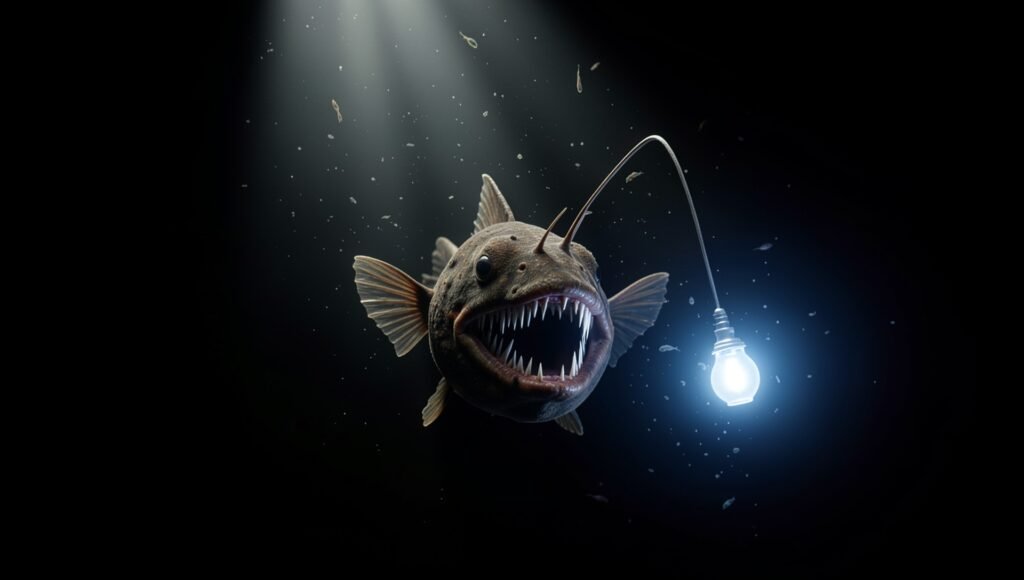
The really surprising finding is that glowing lures appeared later, particularly in some deep-sea groups. Researchers found a pattern of higher speciation rates among anglerfishes with glowing lures. This suggests that bioluminescence may have helped not only with catching prey but also potentially with finding or signaling to mates in the darkness of the deep ocean. (Phys.org)
That gives you a strong new headline:
“Scientists Discover the Anglerfish Light May Be More Than a Hunting Tool”
Another interesting 2026 report explored the possibility that anglerfish use their glowing lures as a form of communication. Some males have relatively large eyes and noses, and researchers suggest that the light may potentially provide signals that help males locate females in the enormous darkness of the deep sea. (National Geographic)
There is also an important 2025 discovery/observation worth adding to your article. Researchers encountered a rare humpback anglerfish (Melanocetus johnsonii) near Tenerife, apparently close to the ocean surface in broad daylight. This was extraordinary because the species is normally associated with depths of approximately 200–2,000 meters. Scientists still don’t know exactly why the animal appeared so close to the surface. (Oceanographic)
“Latest Anglerfish Discoveries in 2026”
and covering these three points:
- The fishing lure may have evolved around 72 million years ago.
- Glowing lures may help anglerfish find mates as well as prey.
- Scientists continue to encounter extremely rare deep-sea anglerfish near unusual locations.


