




New Species, Glowing Lures and Deep-Sea Secrets
Anglerfish are among the most mysterious animals in the world’s oceans, and scientists continue to discover surprising facts about them. These unusual fish live in environments that are extremely difficult for humans to explore. In the deepest parts of the ocean, there is almost complete darkness, enormous water pressure, low temperatures and very little food. Yet anglerfish have evolved extraordinary adaptations that allow them to survive. Recent research and rare observations are revealing new information about their evolution, reproduction, bioluminescence and diversity.
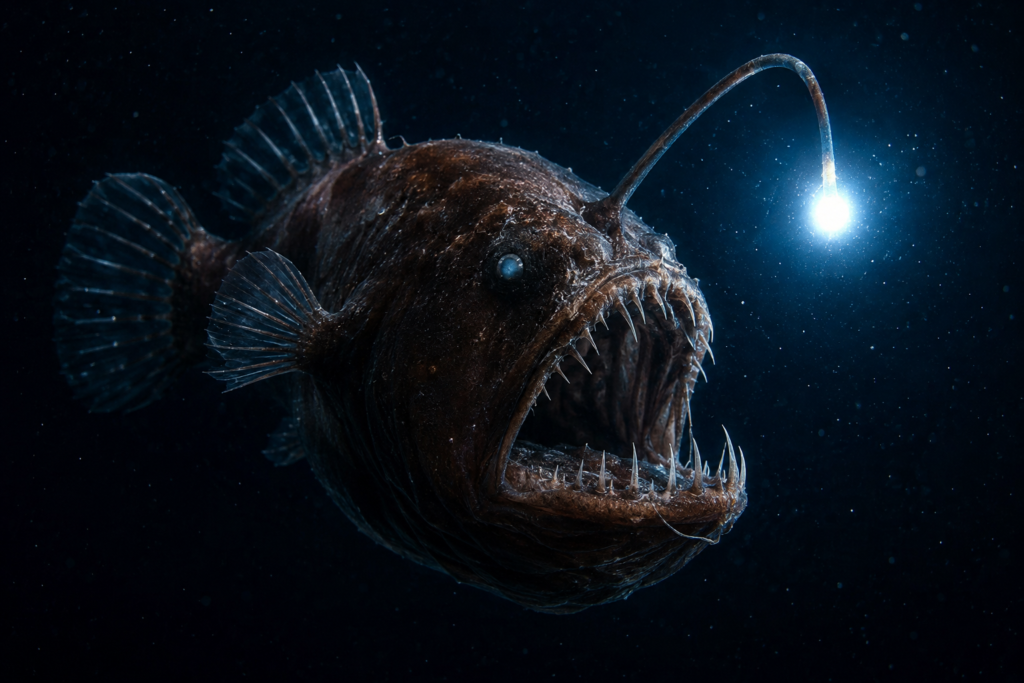
One of the most interesting recent developments concerns the famous anglerfish light. Many deep-sea anglerfishes possess a specialized structure that resembles a fishing rod. At the end of this structure is a glowing organ called the esca. The fish can use this light-producing lure to attract prey toward its enormous mouth. Scientists have long known that this adaptation is useful for hunting, but newer evolutionary research is investigating whether the glowing lure may have played an even larger role in the diversification of anglerfishes.
Research published in 2026 examined the evolutionary history of anglerfishes and the development of their remarkable fishing apparatus. Scientists found evidence suggesting that lineages possessing glowing lures experienced particularly interesting patterns of diversification. This raises an important question: could the evolution of bioluminescent fishing equipment have helped anglerfishes exploit different ecological opportunities and eventually contributed to the evolution of new species? The discovery provides another reason why the anglerfish light is considered one of the most remarkable adaptations in the deep ocean.
Another major area of research involves the extraordinary difference between the angler fish male and angler fish female. In some deep-sea anglerfish species, males are incredibly small compared with females. A male may spend much of its life searching for a female in an enormous and almost completely dark ocean. Finding a mate in such an environment is extremely difficult. Evolution has produced an extraordinary solution in several groups: the male can attach itself to the female.
In some species, the male becomes permanently attached to the female and can obtain nutrients from her body. The relationship can become so intimate that the male’s body undergoes dramatic changes. This unusual reproductive strategy has fascinated scientists for decades. More recent genetic research has helped explain how such extreme sexual parasitism could evolve. Changes involving the immune system appear to have been particularly important because permanent attachment between two individuals would normally create serious biological problems.
Scientists are also continuing to document new and poorly known species. A notable example is the deep-sea anglerfish Gigantactis paresca, which was recognized among remarkable new marine species reported in recent years. Discoveries such as this demonstrate that the diversity of deep-sea anglerfishes is still not completely known. Every research expedition into poorly explored ocean environments has the potential to reveal species that have never previously been scientifically documented.
The discovery of new species is particularly important because scientists cannot understand the evolution of anglerfishes by studying only a few famous examples. Different species can have dramatically different body shapes, lures, reproductive strategies and habitats. Some have enormous mouths and long teeth, while others possess highly specialized structures for attracting prey. Comparing these differences helps researchers reconstruct how anglerfishes evolved and adapted to the deep ocean.
The black angler fish has also attracted considerable attention. Some deep-sea anglerfish species have extraordinarily dark bodies. Their pigmentation can absorb much of the available light, potentially making them extremely difficult to detect in the darkness of the deep ocean. This is especially useful in an environment where animals may produce or encounter bioluminescent flashes.
A remarkable observation in 2025 provided scientists and the public with an unusually close look at a black deep-sea anglerfish. A black seadevil, also known as a humpback anglerfish, was filmed near the Canary Islands. Such observations are exceptionally rare because these animals normally inhabit deep water. Seeing one alive in unusual circumstances provided valuable visual information about its appearance, movement and behavior.
Another fascinating discovery involves anglerfishes whose bioluminescent organs are located in unexpected places. The genus Thaumatichthys, for example, contains species with a remarkable glowing structure positioned inside or near the mouth rather than using the familiar lure projecting above the head. This unusual arrangement demonstrates that evolution has produced multiple solutions to the same fundamental problem: how to attract prey in a nearly lightless environment.
The deep ocean itself remains one of the greatest challenges to anglerfish research. Traditional deep-sea sampling often involves trawling, which can damage delicate animals or bring them to the surface after exposure to dramatic changes in pressure. Modern remotely operated vehicles, autonomous underwater vehicles and deep-sea cameras are changing this situation. Scientists can increasingly observe animals in their natural environment rather than relying entirely on specimens collected from the ocean floor.
These technologies may lead to many more discoveries. Scientists still know surprisingly little about the everyday behavior of many deep-sea anglerfishes. Questions remain about how frequently they use their lights, how they recognize potential mates, how they communicate, how they reproduce and how their populations are distributed across the deep ocean.
The latest research therefore shows that anglerfish are much more than strange-looking predators with glowing lures. They are examples of extraordinary evolutionary innovation. Their angler fish light, extreme male-female differences, dark coloration, specialized hunting equipment and unusual reproductive systems demonstrate how life can adapt to environments that appear almost impossible to survive in.
As exploration of the deep ocean continues, scientists may discover many additional anglerfish species and behaviors. The next major discovery could reveal a completely new type of lure, an unknown reproductive strategy or an unexpected use for bioluminescence. For this reason, the anglerfish remains one of the most fascinating subjects in modern marine science—and one of the clearest reminders that much of Earth’s deep ocean is still waiting to be explored.


