


How to Check Car Battery Health
Checking your car battery’s health regularly can help prevent unexpected starting problems. A simple inspection can be done at home, while a multimeter or battery tester can provide a more accurate assessment.
1. Check the Battery’s Appearance
Turn off the engine and inspect the battery. Look for:
- Cracks or damage to the battery case
- Swelling or bulging
- Battery-fluid leakage
- Heavy corrosion around the terminals
- Loose or damaged cables
A swollen, cracked, or leaking battery should be inspected by a qualified technician.
2. Check the Battery Terminals
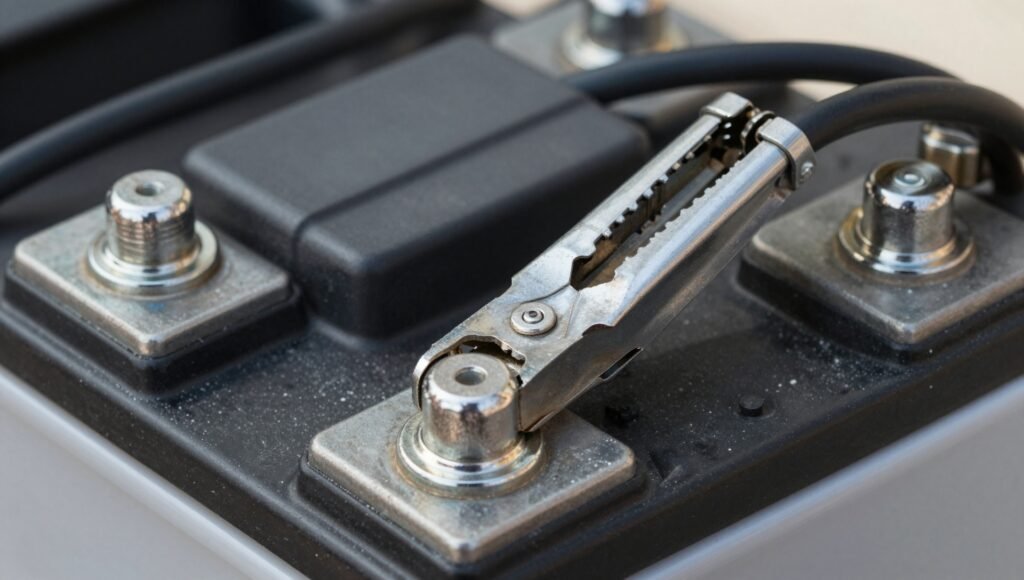
Make sure the positive and negative terminals are clean and firmly connected. White, blue, or greenish corrosion around the terminals can interfere with electrical flow and may cause starting difficulties.
3. Measure Resting Voltage
A digital multimeter can be used to measure battery voltage. With the engine switched off and the car resting for several hours, connect the red probe to the positive terminal and the black probe to the negative terminal.
As a general guide for a typical 12-volt lead-acid battery:
| Voltage | Approximate condition |
|---|---|
| 12.6–12.8 V | Fully charged |
| 12.4 V | About 75% charged |
| 12.2 V | About 50% charged |
| 12.0 V | About 25% charged |
| Below 12.0 V | Very low charge |
These figures indicate state of charge, not necessarily the battery’s overall health. A battery can show a reasonable voltage but still have poor capacity.
4. Check Voltage With the Engine Running
Start the engine and measure the voltage again. In many conventional vehicles, a healthy charging system will typically show roughly 13.7–14.7 volts, although the correct range varies by vehicle and charging system. If the voltage is consistently too low or unusually high, the alternator or charging system may need inspection.
5. Observe Engine Starting
Pay attention when starting the vehicle. Slow or hesitant cranking, repeated clicking, or difficulty starting—particularly after the car has been parked overnight—can indicate a weak battery or another starting-system problem.
6. Perform a Battery Load or Conductance Test
For a more reliable health assessment, use a dedicated battery tester or have a workshop perform a load/conductance test. This can determine whether the battery can deliver sufficient starting power, something a simple voltage measurement cannot establish.
Important: If the battery is swollen, cracked, leaking, or becomes unusually hot, avoid handling it unnecessarily and have it inspected by a professional.


